

Web design in Fairfield County, built for the way people actually search here.
You run a business somewhere between Greenwich and Danbury, and you cannot tell whether you should be competing for your own town's name, the county's, or just "near me." That question decides where your money goes. This page answers it, then covers the web design, local search, and AI work behind it, all of it owned by you.

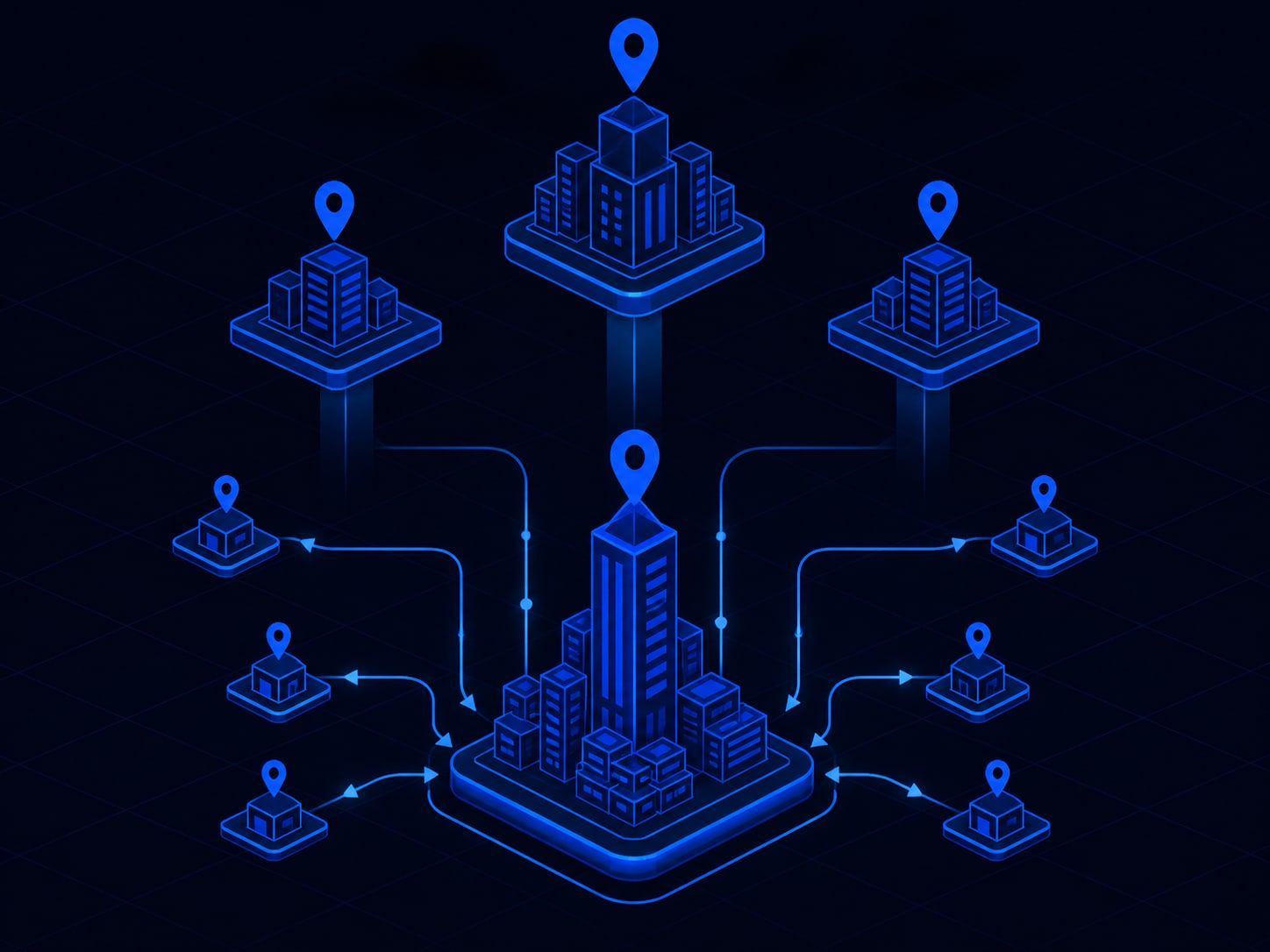
The shoreline corridor, the Bridgeport area, and the inland towns, drawn as the three distinct markets they are.
Town, county, or near me?
Here is the question nobody answers for you. You are in Monroe, or Weston, or Bethel. Do you try to rank for your own town, where the searches are few but the competition is thin? For the bigger neighbour, where the searches are many and the competition is fierce? Or for "near me," which is decided by where the searcher is standing and not much else?
Guess wrong and you spend a year competing for a term you were never going to win, or you win a term nobody searches. Both feel like the marketing did not work. Neither is a website problem.
The answer depends on which of the three Fairfield Counties you are actually in, because there are three and they behave differently:
- The lower shoreline corridor, Greenwich through Stamford, Darien, Norwalk, Westport, Fairfield, Bridgeport and Stratford. Dense, competitive, and the towns are close enough that people cross them without thinking.
- The Greater Bridgeport area, centred on Bridgeport and the municipalities around it.
- The inland and Greater Danbury area, Danbury, Bethel, Brookfield, New Fairfield, Newtown, Ridgefield, Redding and Sherman. More spread out, so travel distance shapes what a customer will consider.
A business in Sherman and a business in Stamford are not running the same play, and a single package across both is a package rather than a plan.
Some towns carry their own page. Some are better served from here.
Search demand is not evenly spread, and pretending otherwise is how agencies sell nine identical town pages to a town of four thousand people. There is no public dataset that gives keyword volume town by town, so anyone quoting you one has made it up. What can be said honestly is which towns have the population and commercial concentration to carry their own search, and which are better served by a county page that routes properly.
The larger markets, where a dedicated page earns its place, are Stamford, Bridgeport, Norwalk, Danbury, Greenwich and Fairfield. A second group sits just behind them: Stratford, Shelton, Westport, Trumbull, Darien, New Canaan, Ridgefield, Wilton and Bethel.
Then there are the towns where a standalone page is mostly vanity: Monroe, Newtown, Weston, Easton, Redding, Brookfield, New Fairfield and Sherman. These are the businesses this page is really for. You are not going to out-rank a Stamford agency on volume, and you do not need to. You need to be findable to the people already near you, and to show up when somebody searches the county or the region rather than one specific town.
We already have dedicated pages for several of the larger markets. If you are in one of them, start there, because they go deeper on that town than this page can:
- Web design in Stamford, the corporate and finance market
- Web design in Greenwich, where the work runs on relationships
- Web design in Norwalk, a city of several economies at once
- Web design in Fairfield, the shoreline college town
- Web design in Darien, compact and trust-led
- Web design in Ridgefield, the arts-minded village centre
“There is no public source for keyword volume town by town. Anyone quoting you one has invented it.”
The site first, then the search work. In that order, for a reason.
The website comes first, because everything local hangs off it. We build a custom site designed around your business, hand-coded on Next.js and shipped as static files, which is the plain reason it loads fast. No page-builder weight dragging every visit, no theme somebody bought and recolored for a demo company that is not yours. Real HTML on every page, so search and AI engines see your full content the moment they arrive instead of an empty shell waiting on scripts. That starts with custom web design, the service everything else here is built on.
Then the search and marketing work, run as its own layer and shaped by which of the three areas you are in:
- Local SEO for the near-me and town searches, including the service-area setup that matters when you sell across several towns rather than from one storefront.
- Google Business Profile management to keep the profile complete, accurate and consistent with the site, because a profile that fights your website ranks neither.
- Search engine optimization at the technical level: metadata per page, structured data, a sitemap that updates itself, and clean, stable URLs.
- Content marketing and, when you are ready, an online store built on custom e-commerce that you own instead of rent.
Hours back, not a slogan. Start with the task you repeat.
Every agency is saying "AI" right now, and most of it is noise. Here is the part that is not. AI is the intake form that answers itself at eleven at night, the follow-up that sends itself before you remember to, and the site assistant that qualifies a lead while you are on a job in the next town. For an owner covering several towns, that is hours back in the week, not a buzzword.
We start with a read of where AI genuinely saves you time and where it is just for show. Then we wire the pieces that earn their keep: AI automation for the repetitive work in your week, and chatbots trained on your business that answer, qualify and book while you work.
You are buying an asset. Make sure it is in your name.
Ask any agency one question before you sign: "If we part ways next month, what do I keep?" Where the site was never in your name, the answer is a cancellation email and nothing else, because you were renting it the whole time. The domain sat in their account. The analytics, the hosting, the content, all on their side of a login you never got.
In a county where the budget question is really a targeting question, ownership is the part that does not move. Everything we build ends up in accounts registered to you: the design, the content, the domain, the analytics, the data. We keep it safe and running so there is nothing technical for you to babysit, but the ownership is real and it is yours from day one. If you ever want to go, everything leaves with you, and any developer can pick it up the same day. No monthly ransom. The door is never locked.
“If you cannot take your site and leave, you do not own it. You rent it.”


Four steps. You always know which one we are in.
No mood boards, no mystery, no big reveal at the end. We are not a storefront on Greenwich Avenue or in downtown Danbury, and we will not pretend to be. The work itself, design, build, SEO and support, runs beautifully at a distance, and a good share of our clients are people we have never stood in the same room with. Where you serve shapes how we position your site in local search. It does not decide whether we can build it.
Decide the target
Before any design, we settle the question at the top of this page: which towns you actually compete in, whether the county term is worth carrying, and where "near me" does the work for you. That decision shapes the sitemap, not the other way round.
Design and build
We design the system, type, color, spacing and page patterns, then hand-code every page on Next.js from it. Local SEO plumbing laid as we go: per-page metadata, structured data, clean URLs, and the Google Business Profile groundwork, rather than retrofitted at the end.
Prove it works
Quality by numbers, not by eye. Speed audited on the production build so the site passes Core Web Vitals outright. Real phone widths checked for anything that clips or drags sideways. Rendered HTML inspected so we know engines and AI see your full content.
Launch and hand over
Domain pointed, analytics live in your account, sitemap submitted, and the Google Business Profile lined up with the site so local search reads one consistent story. Then the handover: credentials, accounts, and a walkthrough, handed to you and yours to keep.
1

Ready when you are. Your work, actually yours.
Tell us about your business and what this needs to cause. You'll have a plan back within one business day, including when the answer is that you do not need this.
Tell us your caseDesign QA on a Fairfield County build: speed, mobile widths and rendered HTML checked by number.
The ones that decide a budget.
What does a website cost around here?
There is no honest average, and the number you see quoted on a Fairfield County agency's home page is a starting package rather than a price for your job. What is honest is what drives it: how many pages carry real content, whether you are quoting or selling, how much has to connect to systems you already run, and how much writing and photography is still to be done. A five-page site for a Redding contractor and a store for a Westport retailer are different orders of work. We break the real drivers down in what a custom website really costs, and we quote in writing before anything starts.
Ask us about a website in Fairfield CountyHow do I pick a web design company?
Ask three questions and listen to how they are answered. First, show me work like mine, and let the answer be a real named project rather than a wall of logos. Second, what is in scope and what happens after launch, in writing. Third, if we part ways next year, what do I keep? A shop that cannot answer the third one plainly is telling you that you would be renting. Cheap and fast are easy to promise on a sales call and expensive to find out about afterwards.
Talk your Fairfield County project through with usShould I target my town or the whole county?
Usually your town first, then the county term as a second layer, and "near me" handled through your Google Business Profile rather than a page. The exception is a smaller town like Weston, Easton or Sherman, where the town's own search volume is thin and a county-level presence plus a strong profile does more work. We settle this before the sitemap is drawn, because it decides the whole structure.
Ask if this is the right fit for Fairfield CountyDo you have a Fairfield County office?
No, and we will not claim one. The work runs at a distance and a good share of our clients are people we have never met in person. What your location decides is how we position you in local search, not whether we can build for you.
Tell us what you need in Fairfield CountyWhich towns do you serve here?
All 23 in the county, from Greenwich and Stamford along the shoreline to Danbury, Newtown and Sherman inland. Several of the larger towns have their own page on this site; the rest are served from here.
Ask how we work with businesses in Fairfield CountyCan you get me into the map pack?
That is the goal of the local work. A complete Google Business Profile plus a fast, well-structured website is what earns relevance and prominence, two of the three things Google ranks the map pack on. Distance is the one nobody can move, and we never promise a specific placement.
Get a straight answer about Fairfield CountyWill I lose my Google rankings if you rebuild my site?
No. Before anything moves, we inventory every URL on your current site and map each one to its new home with proper redirects, so the authority you have earned carries over. Rankings usually end up better after the move, because the new site is faster and cleaner.
Have us look at your Fairfield County siteWill I own the website, the domain, and the accounts?
Yes, all of it. The code, content, domain, analytics and data live in accounts registered to you. Nothing is held hostage, and if you ever leave, everything leaves with you.
Start a conversation about Fairfield CountyTell us which towns you actually sell into and what is happening now. We will reply within one business day with a straight read on whether your town, the county, or your profile is the thing worth fighting for. That is our job, not yours.
About Fairfield County
Fairfield County had a population of 957,419 residents at the 2020 Decennial Census, across 625.0 square miles of land and 378,479 housing units. Connecticut abolished county government in 1960, so it is a geographic and colloquial place name rather than an administrative one: accurate as a service area, inaccurate as an authority. The area runs from the dense coastal corridor along Long Island Sound through the Housatonic and Saugatuck watersheds into wooded, hillier inland towns.
It is not a single housing market and should never be described as one. Bridgeport and parts of the coast include dense urban and multifamily housing; the lower shoreline towns hold established suburban and high-value coastal housing; inland areas are lower-density, wooded and rural-residential. State housing analysis documents sharp market segregation across the area and warns against treating its prosperity as uniform.
Towns and cities we serve here
Around Fairfield County
Bordering areas
Getting around
Interstate 95 / Connecticut Turnpike · Route 15 / Merritt Parkway · Interstate 84 at Danbury · U.S. Route 1 · Route 7 · Route 8
Do not see your town on the list? We work across Fairfield County and beyond. Tell us where you are and we will tell you whether we can help.