


Open any AI tool and ask it about your business. It answers with confidence and gets the details wrong, because it knows nothing about you. Not your prices, not your policies, not a single customer. So, your team pastes the background in again, every conversation, a slightly different version each time.
That gap, between how smart the AI is and how little it knows about your company, is the ceiling almost every business hits. An AI knowledge base is how you lift it: one owned, structured memory your AI can actually draw on, so it works from what is true about your business instead of a fresh guess.
Here is what it is, how it works, and why it is the piece most businesses are missing.
Key Takeaways
It is the owned context layer your AI reaches for before it answers, and one knowledge base can feed a chatbot, an internal assistant, and your automations at once.
Instead of your team re-pasting the same background into every chat, approved company information is retrievable on demand.
The system finds the relevant passages for a question and hands them to the AI, so answers are grounded in your real documents and cite their source.
A named source of truth, clear labels, and an update routine are the difference between right answers and confident wrong ones.
The AI should only retrieve what the person asking is allowed to see, especially once customer data is involved.
The documents, the database, and the accounts belong to you, so you are never renting your own company's knowledge back from a vendor.
The Blank-Slate Problem, and What It Costs
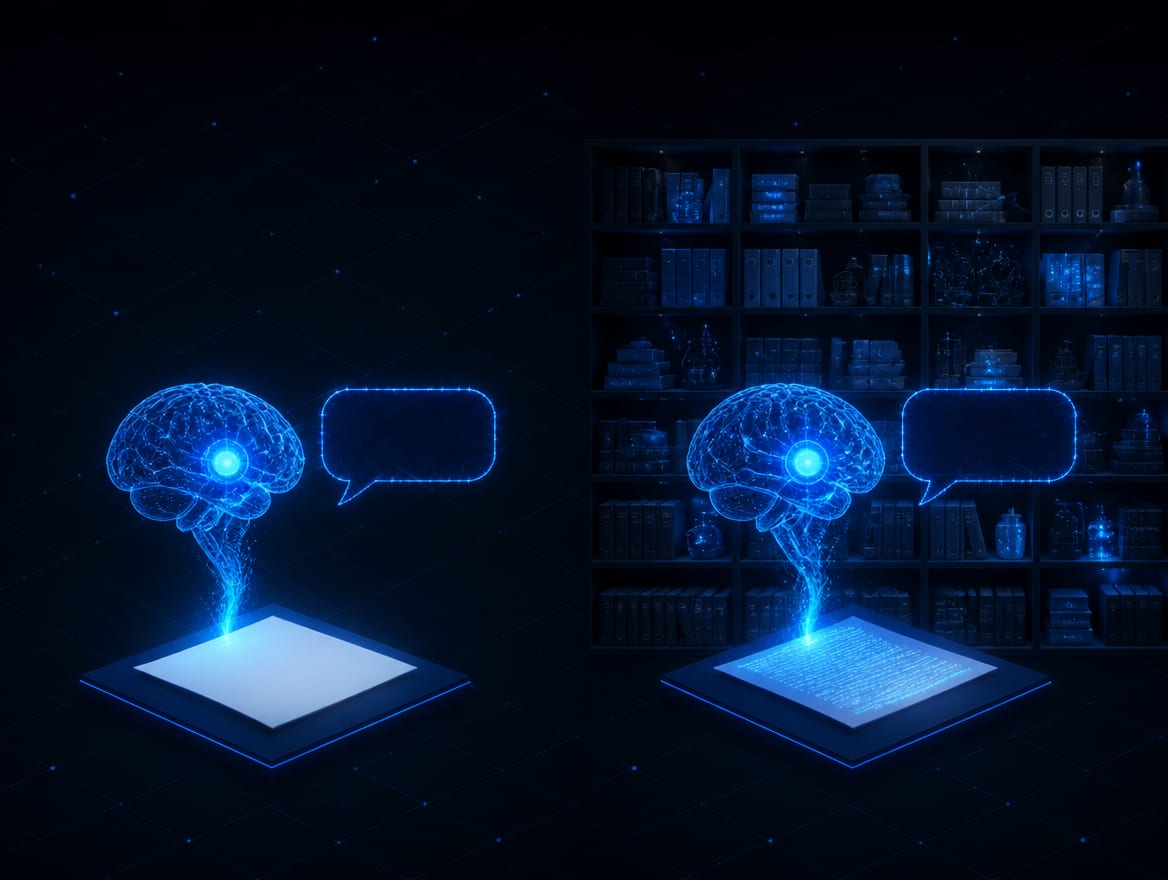
Every fresh AI conversation starts from zero. The model has enormous general intelligence and no memory of your business, so the burden falls on your people. They paste in the service list, the current pricing, the policy from last quarter, the customer's history, just to get one useful answer. Then the next employee does it again, with a slightly different version of the facts. The result is slow work, inconsistent answers, and an AI that never gets better at your business because it never remembers it.
That is the real cost, and it is easy to miss because no single instance looks expensive. Ten minutes of context-setting here, a wrong answer there, two employees giving customers two different stories. Add it up across a team and a month, and the "free" AI tool is eating hours and eroding trust. A knowledge base removes the re-explaining entirely, because the context is stored once and retrieved whenever the work needs it.
So What Is an AI Knowledge Base, Exactly?
An AI knowledge base is a persistent, structured store of your approved business information, organized so any AI tool can pull the right piece at the right moment. It holds the things a model could never know on its own: your services and pricing, your standard procedures, your FAQs, your policies, and, when you connect it, your customer and communication history.
The most important distinction is this: a knowledge base is not a chatbot. A chatbot is an interface, the box people type into. A knowledge base is the context layer underneath, the memory the AI reaches for before it answers. That difference matters because one knowledge base can power many interfaces at once: the chatbot on your website, an internal assistant your staff query, and the automations running in the background. You build the memory once, and everything you plug into it gets smarter. Confuse the two and you buy a mouth with nothing behind it.
How It Actually Works: Retrieval, Not One Giant Prompt
The common method behind a knowledge base is called retrieval, or RAG (retrieval-augmented generation). In plain terms: instead of stuffing your entire company history into every prompt, the system stores your information in a searchable form, finds only the passages that relate to the question, and hands those to the AI right before it answers. The reply comes back grounded in your real documents, with a link back to the source so anyone can verify where it came from.
You will hear three pieces of jargon, and they are simpler than they sound.
RAG
The retrieve-then-answer method above. The AI pulls approved information first, then answers from it, instead of guessing from memory.
Embeddings
A way of turning your text into something a computer can search by meaning, not just by matching exact words. It is what lets a search for "refund rules" find the passage titled "return policy."
Vector Database
Simply where that searchable form is stored. It is the filing cabinet, not the magic.
None of those words prove a system is any good. What proves it is whether the system pulls the right passage, cites it, and respects who is allowed to see it.

What Goes In It, and Why Structure Decides Accuracy
The knowledge base holds everything the model can't guess: your current services and prices, your procedures, your FAQs, your policies, and your customer history when connected. Today that lives scattered across documents, folders, and the memory of the one person who "just knows." In one place, it becomes retrievable in seconds.
But a pile of files is not a memory, and this is where most attempts fail. Dumping every document into a tool and hoping the AI sorts it out produces confident, wrong answers. Accuracy comes from the plumbing underneath: a named source of truth so the AI never quotes last year's price as current, clear labels and structure so retrieval finds the right passage, a link back to the original so a human can verify in one click, and an update routine because prices and policies change and a stale memory becomes a liability. Do that work and the AI stops guessing. Skip it and you have an expensive way to be wrong faster.

Permissions: One Memory, Not One Open Door
The moment customer history, pricing, or private messages enter a knowledge base, "who can retrieve this" becomes the whole game. A serious build treats the knowledge base as permission-aware, not one open pool where anyone with access can pull anything. Retrieval respects the person asking, so a front-desk assistant and an owner do not get the same answers to the same question.
That means governance decided before anything is loaded: which data is allowed in, who may retrieve each kind, where it is stored, and who can delete or export it. Customer records sit behind tighter access than a public FAQ. Every retrieval is logged. This is ordinary discipline for handling business data, and it is exactly what a file-upload-and-pray setup skips.

Chatbot, Fine-Tuning, or Knowledge Base? A Quick Comparison
The three get confused constantly, and they solve different problems. Here is the plain version.
| Approach | What it actually is |
|---|---|
| AI knowledge base | The owned memory layer: approved company info, retrieved and cited on demand, feeding any AI tool |
| Chatbot | An interface that talks to visitors or staff; it works best sitting on top of a knowledge base |
| One long prompt | Pasting context into each chat; it doesn't scale, gets stale, and every person writes it differently |
| Fine-tuning a model | Retraining a model on your data; expensive, slow to update, and still no live source citations |
For nearly every business, the knowledge base is the foundation, and a chatbot or automation sits on top of it. Fine-tuning is rarely the right first move, and anyone leading with it for a normal business problem is usually selling complexity you don't need.
Quick Check: AI Knowledge Bases
Pick an answer to begin.
1. What is the main difference between a chatbot and a knowledge base?
2. Why does structure matter so much in a knowledge base?
3. Who should own the data and database in a well-built knowledge base?
Frequently Asked Questions About AI Knowledge Bases
What is an AI knowledge base in simple terms?
It is a structured, owned store of your approved business information that AI tools can retrieve and use before they answer. It gives your AI real context about your company instead of a blank slate.
Is it the same as a chatbot?
No. A chatbot is one interface people type into. A knowledge base is the memory behind it, and one knowledge base can feed a chatbot, an internal assistant, and your automations at the same time.
What is RAG?
RAG, or retrieval-augmented generation, is the method most knowledge bases use. It retrieves the relevant approved information first, then lets the AI answer from it, with a link back to the source.
Can it remember customer history?
Yes, when your customer data is connected with the right permissions and controls. Access rules are built in from the start, so customer records sit behind tighter access than a public FAQ.
Do I have to pick one AI model forever?
No. The knowledge base is separate from the model that reads it, so you can change AI tools without rebuilding your memory. That separation is deliberate and part of not being locked in.
How accurate is it?
Accuracy depends on the quality of your sources, how well the content is structured, and ongoing testing, not on any single piece of technology. A good build tests retrieval against your real questions and is honest that no system is perfect.
Final Thoughts
An AI knowledge base is the difference between an AI that guesses about your business and one that actually knows it. It is the owned memory layer, structured so retrieval is accurate, permission-aware so it can be trusted with real data, and separate from any one model so you are never locked in. Build it once and every tool you connect, the chatbot, the internal assistant, the automation, draws from the same source of truth.
The payoff is quiet but compounding. Your team stops re-explaining the business, your answers stop drifting, and the knowledge you have spent years accumulating finally becomes something your AI can use instead of something trapped in scattered files and one person's head.
At Web Leveling, we build the AI Knowledge Base as an owned asset: your documents, your database, your accounts, structured for accurate retrieval and built to last. If your AI keeps starting from a blank slate, contact us and we will send back a clear, workable plan within one business day. Build the memory once; everything you plug into it gets smarter.
Terms
AI Knowledge Base: Key Terms
Tap a term to see what it means.
RAG. Retrieval-augmented generation. The AI retrieves the relevant approved passages from your knowledge base first, then answers from them, instead of guessing.
Embeddings. A way of turning your text into something a computer can search by meaning, not just by matching exact words.
Vector database. Where that searchable form of your content lives. It is the filing cabinet, not the magic.
Retrieval. Finding the few passages that actually relate to a question and handing them to the AI right before it answers.
Source of truth. The document the system treats as authoritative when two sources disagree, so the AI never quotes a stale price as current.
Permission-aware. Retrieval that only ever returns what the person asking is allowed to see, set by role rather than left wide open.