

AI process automation consulting, for people handed a mandate instead of a map.
You are not short on AI advice. You are short on a map. This is the service that walks your actual week, finds the hours automation can genuinely give back, and says out loud where AI is just noise dressed up as progress.

The noise on one side, the two moves that matter on the other.
You're not behind. You're just drowning in advice.
Here is the strange thing about AI right now. Everyone is telling you to use it, and almost nobody is telling you where. Your inbox has a webinar. Your competitor has a press release. Your nephew has an opinion. A vendor has a demo that looked like magic in a conference room and then did nothing for anyone's business. The word sits on every slide and attaches to nothing you can act on.
So, you feel a low hum of pressure without a single clear move. You suspect there are real hours buried somewhere in your week, and you also suspect that most of what gets sold as AI is a solution shopping for a problem. Both of those instincts are correct, and the gap between them is exactly what this service closes.
“Everyone hands you AI as a mandate. What you needed was a map.”
AI process automation consulting is not a strategy deck and a handshake. It is the plain work of looking at how your business actually runs, finding the two or three places where automation removes real hours or real errors, and telling you plainly about every place where it would not. That is the job. A map of where the tool pays, and where it just costs.
The word consultant tells you nothing.
There is no licence behind the title. Anyone can print it, which means the word on the business card proves nothing about method, training or independence. What separates the people using it is not the label but where they sit relative to the software.
An advisor is paid to study the problem before a tool is chosen, and the output is a decision you can defend with the reasoning attached. An implementer builds the thing once the decision is already made, which is real work and often the larger invoice, but by then the idea has been bought and nobody involved is going to tell you it was the wrong one. A vendor has a product, and the free assessment is part of selling it. None of that is dishonest. It just means the incentive runs one way, and you should know which one you are sitting across from.
We do both halves and keep them separate on purpose. We build the automations, so when we say a workflow is worth wiring here and pointless there, we are the ones who would build it either way. There is no reason for us to oversell it and every reason to tell you the truth, because the fastest way to lose a client is to sell them something that does not work.
That is why the honest no is part of what you are paying for. A consultant who says yes to every idea has told you nothing. The value sits in the sentence that says this one is not worth building, said before you spend on it rather than after. If you want the longer version of this, we wrote it out in what an AI process automation consultant actually does.
Not a slogan. A clear map.
A short, focused look at your real work, and a document a human can read in one sitting that says do this, skip that, and here is why. Nothing in it you have to translate. No roadmap so broad it could describe any company on earth. A map of your business, not a lecture about the technology.
- Where the hours are. The repeated tasks in your week that eat time and attention, listed in your own words, with a note on which ones a tool can genuinely take off your plate and which ones only look that way.
- What each one is worth. Every opportunity scored on the two things that decide it: how many hours or errors it removes, and how hard it is to stand up. High payoff and low effort rises to the top. That is the entire ranking, and it is deliberately simple enough to argue with.
- Where automation is just noise. The parts of your business where AI would be a toy, a risk or a distraction, named specifically, so you can stop feeling guilty about not chasing them. This is usually the section clients quote back to us.
- A plan in plain words. For the moves worth making, a short path: what to try first, what working looks like in real numbers, who owns it, and how you will know within weeks rather than quarters whether it earned its keep.
What you will not get matters just as much. No forty-slide transformation narrative. No promise that AI will replace your team or double your revenue by spring. No push toward one vendor's product, because nobody pays us to point. The map is built around your work, and it stays true whether you build the recommendations with us or hand them to anyone else.
The line nobody draws for you.
The single most useful thing an outside eye can do is draw a clear line between the automation that gives you hours back and the automation that just gives you a demo. Most businesses never see that line drawn, so they either chase everything or freeze and chase nothing. Both are expensive.
The line falls in roughly the same place for most businesses. Automation earns its keep on high-volume, low-stakes, repeatable work: the intake form that sorts itself, the first-draft reply that saves you a blank page, the follow-up that goes out on time instead of never, the pile of notes summarised in seconds instead of an afternoon. Work that happens constantly, where a good-enough answer beats a slow perfect one, and where a person still has the final say. That is the sweet spot, and it is wider than most owners think.
“Automation is worth it where the work is constant and the stakes are survivable. That is the rule.”
Here is where it is mostly noise, said plainly. Rare, high-stakes decisions where being wrong is costly and a human should be reading every word anyway. Anything that depends on data you do not actually hold in usable shape. Tasks that happen twice a year, where the setup time dwarfs the time it would ever save. And the big one: buying a custom model or an AI-first overhaul because it sounds impressive, when an off-the-shelf tool or a fifteen-minute process fix would do the same job for a fraction of the cost.
Frequently the answer is not AI at all. It is a better form, a cleaner spreadsheet, one clear rule, or deleting a step that only exists because of a system nobody uses any more. The cheapest automation in any business is the step that stops happening.

Four steps. No mystery.
You will always know which step we are in and what comes out of it. There is no big reveal at the end, because you see the thinking as it happens. We walk your week, we find the hours, we score what we find, and we hand you a plan a normal person can act on.
Map the week
We start with how your business actually runs, not a menu of AI features. What lands in your inbox, what your team does the same way every day, where things pile up, where the same question gets answered for the hundredth time. We write it down in your words. This is process mapping without the buzzword, and it matters because the version in the handbook is rarely the version people perform on a Friday afternoon.
Find the hours
Against that map we mark the places where automation genuinely removes time or errors. The intake that could sort itself. The report rebuilt by hand every Monday. The follow-up that slips because a person has to remember it. We separate the real hours from the tempting but empty ones, and we flag anything that depends on data or a process you would need to fix first.
Score by return and effort
Every opportunity gets scored on two axes and nothing else: how much it gives back, and how hard it is to build. High return and low effort rises to the top. Big lift and thin payoff sinks. This is where most AI plans die of ambition, and where a plain scorecard saves you from spending six months on the shiny thing instead of six days on the useful one.
The plan, spelled out
You get a short document, not a binder. The two or three moves worth making, in order. For each: what to try first, what working looks like in real numbers, who owns it, and how quickly you will know. Plus the honest list of what to skip, and why. It reads like a plan a human wrote for another human, because it is.
1
A note on time, since it is the first thing people ask. A focused engagement is weeks, not months, and it moves as fast as your answers do. What stretches it is never the analysis. It is waiting on access, on the one person who actually knows how the billing process works, on a straight answer about what the data really looks like. We tell you everything we need up front so the work never idles.
A plan, then the hands to build it.
A map is only worth having if somebody can act on it, and most consulting stops exactly where the acting begins. That is the oldest complaint in this field: you pay for a strategy and are left holding a document with nobody to build it. We are the opposite by design, because we are a build shop that happens to advise rather than an advice shop that happens to know a developer.
So, the map points at real doors and we can walk you through any of them. When the answer is repetitive work that should simply run itself, that becomes AI automation that wires the busywork to run on its own. When it is the same customer questions answered a hundred times a day, that points at a site chatbot trained on your business that answers, qualifies and books while you work. When an off-the-shelf tool genuinely cannot do the specific job, that is where custom AI built around your workflow earns its cost, and only then, never as a default.
“Most consulting stops where the building starts. That's the wrong place to leave you standing.”
Or the door leads nowhere and we say so. Sometimes the map's most valuable line is the one that reads: skip this, it is not worth building. You keep that clarity either way, and for plenty of clients it has been worth more than anything we went on to build.
There is also a quieter payoff worth naming. As buyers start asking AI engines who to hire, being clear and structured about what you do is how those engines learn to recommend you, which is the work behind getting recommended by AI answer engines. Sorting your own AI story out has a way of sharpening the whole business, not just the parts a tool touches.
Ready when you are. Your work, actually yours.
Tell us about your business and what this needs to cause. You'll have a plan back within one business day, including when the answer is that you do not need this.
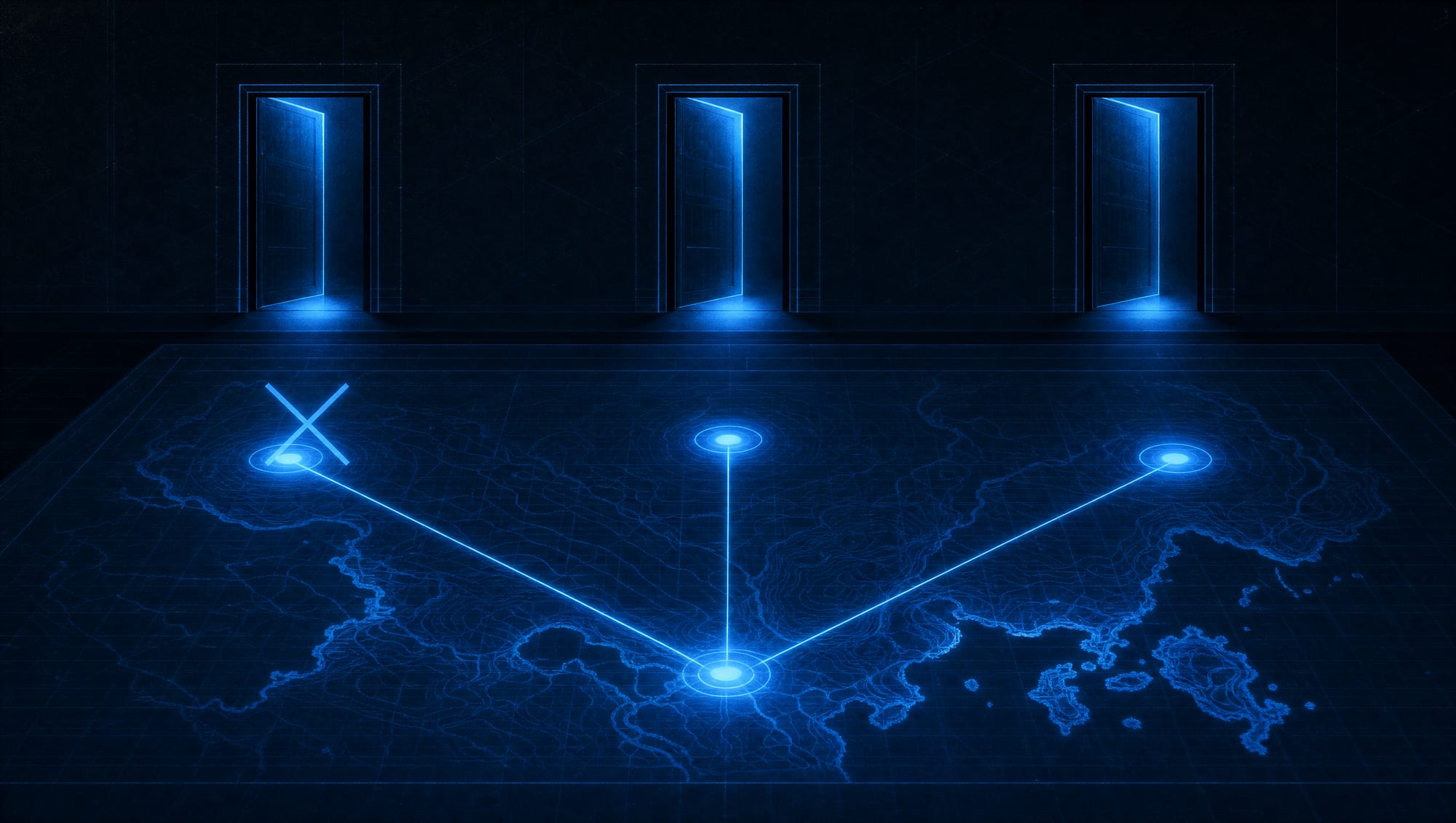
Tell us your caseThe map on the table, three plain doors it points to, and the honest one marked "skip."
The map is yours. So is the exit.
Ask any consultant the clarifying question: if we part ways next month, what do I actually keep? Where the work was never handed over, the answer is a slide deck and a login you no longer control. The prompts, the workflows, the accounts, the setup, all of it sitting inside their systems, dressed up as your strategy.
Here is our answer. Everything leaves with you. The map, the scorecard, the plan, and anything we build from it. Tool accounts are set up in your name from day one, so there is nothing to hand back because you always held it. The prompts and workflows are written down in plain files you keep. If you want to take the whole thing and run it yourself, or hand it to another team, you can do it the same week and it will still work.
That is not generosity and it is not a no-commitment gimmick. It is the product, and it is what keeps us honest, because we keep your business by drawing a map that turns out to be right rather than by locking your setup behind a door only we hold the key to. The door is never locked. That is true wherever you are, whether your team sits one town over or on the other side of the world.
Asked and answered, before the call.
What does AI process automation consulting actually cost?
A focused engagement is quoted as a flat number you see before we begin: a setup fee and a scope, with no hourly meter running in the background. The honest drivers are how many processes we map, how many people we speak to, and whether you want the plan only or the plan plus the building. If part of your work turns out not to need us, we will say so rather than pad the number.
Get AI Consulting priced for your businessHow is this different from just buying an automation tool?
A tool is an answer. Consulting is working out the question first. Plenty of businesses buy the tool, wire it to a messy process and get a faster mess. The map tells you which tool, aimed at which task, is worth the effort. Sometimes the finding is that you already own something that does the job and are not using it properly.
Ask how we actually run AI ConsultingWill you tell me not to automate something?
Yes, and often. We will name the places where a tool would be a risk, a toy, or slower than what you already do, so your time and money land only where they earn it. A recommendation to automate every process is a sales position rather than an assessment.
Ask what AI Consulting is built onAre you tied to one vendor or platform?
No. Nobody pays us to point at their product, so the map is built around your work rather than around a platform we are obliged to sell. Where an off-the-shelf tool is the right call we say so, and where something custom is genuinely needed we say that too, and only then.
Ask us about AI ConsultingDo you also build what you recommend?
We can, and that is the point of taking advice from a build shop. The map can end as a document you take anywhere, or it can roll straight into the work in the order the scorecard set. Either way the plan stands on its own and belongs to you.
Talk AI Consulting through with usHow fast will I know whether it worked?
Weeks, not quarters. Every move we recommend comes with a small first test and a number attached, so you see whether it earns its keep on real work before anyone commits to scaling it. If the test falls flat, that is a cheap and fast answer, which is exactly the point of testing small.
Ask how long AI Consulting takesWhat should I have ready before we talk?
One process you can describe, a rough sense of how often it happens, the systems it touches, and a couple of the awkward cases that break the normal steps. That preparation is worth more than any tool comparison, and it turns the first conversation into an inspection rather than a pitch.
Ask if AI Consulting is the right callIf you have been told to use AI one more time without a single clear place to start, that is the problem this solves. Tell us what your week actually looks like and we will tell you straight where automation pays, where it does not, and what we would do first.