


SEO for medical practice with multiple locations tends to land on your desk at the worst hour. It is late, you have a list of offices open in front of you, and one of them shows the wrong hours.
Maybe the newest office has a handful of reviews. Maybe every city search on your website drops the visitor on the homepage. Meanwhile a patient is looking for the nearest door and cannot tell which one it is.
You also carry a worry that a retail shop never has. A friendly reply to a review, or a patient story on a page, can turn into a privacy or licensing problem.
Both worries start with the same short check, and you can run it alone tonight. After that, the work is a handful of fixes done in a sensible order, with one named person approving anything clinical.
Key Takeaways
Match the address, phone, hours, providers and booking path on your website to each office's Business Profile, then fix the riskiest mismatch first.
Google says to create one Business Profile for each eligible physical location and not more than one page for each location.
A public-facing practitioner with a direct patient base may have a profile of their own, and support staff do not qualify.
HHS says providers may not disclose protected health information in review replies, so thank the reviewer and invite a private conversation.
Clinical, insurance, provider, testimonial and review-reply language needs a named approver, and no change guarantees rankings or patient volume.
Check every office against itself before you change anything
Start with a plain sheet of paper or a spreadsheet, one row per office. Write each office's address, phone number and hours exactly as printed on your website. Then open that office's Google Business Profile and compare the two, field by field.
Mark every mismatch, but do not edit clinical services, insurance information, provider status or review replies until the practice confirms the current facts. Google's Business Profile guidelines are the rulebook for what a profile may show, so keep them open while you work.
The ten-minute office check
Compare the business name and street address with the profile, including the suite number.
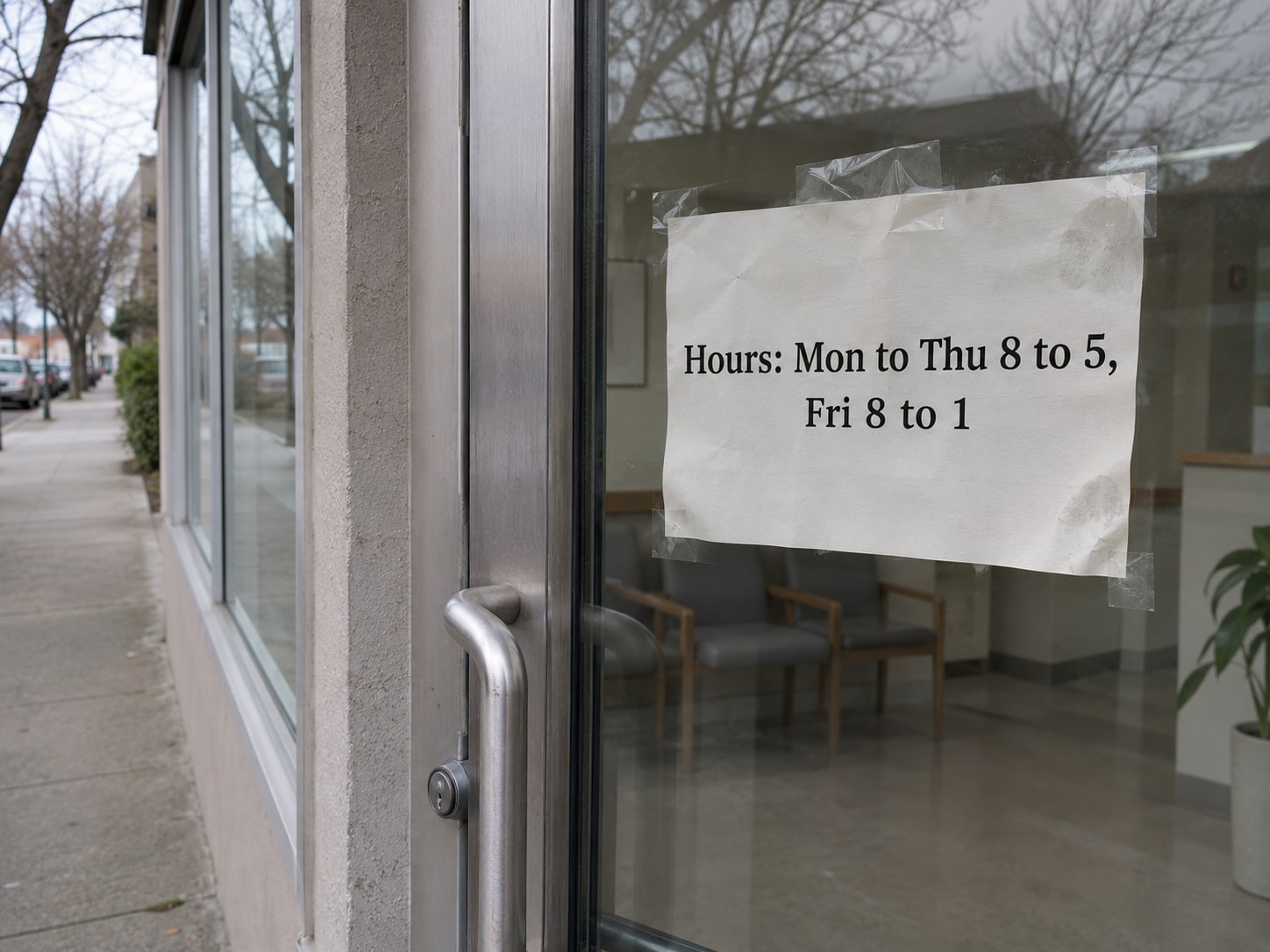
Check the regular hours, holiday hours and the number each office answers.
The profile should open the right office page, and that page should link back to the right profile.
Confirm that the people and services shown actually belong to that office.
Note whether each profile is verified, suspended, duplicated or missing.
Fix the riskiest mismatch first. A wrong address, a wrong phone number, wrong hours, a duplicate or suspended profile, a provider listed at the wrong office, or a page promising a service that office does not offer all send a patient to the wrong place.

Each real office gets one profile, and some practitioners can have their own
Google says to create one Business Profile for each eligible physical location and "do not create more than one page for each location." Use the real business name, an accurate address, a phone number or website specific to that office, and consistent categories. One profile standing in for several offices leaves the second and third office without a listing of its own.
A practitioner can have a profile too, but only under Google's conditions. The person must be public-facing, have a direct patient base, and be reachable at the verified location during stated hours. Where several practitioners work at one site, the organization profile and each eligible practitioner profile are separate. Support staff do not qualify.
So, a three-office dental group might have three office profiles and a profile for each dentist who meets those conditions. The hygienist and the front desk do not get one. Our post on Google Business Profiles for practitioners and departments walks through who qualifies in more detail.
If an office is missing from Maps, check the status of its profile first. A profile that was never claimed, was duplicated, or was suspended behaves differently from one that simply has not been verified yet, and each needs a different fix.
A location page works when everything on it is true for that one office
Patients searching for a nearby office need a page that answers four questions: where is it, when is it open, who works there, and how do I book. Each page should carry only what is true for that office: the complete street address, a local phone number, current hours, appointment instructions, parking or transit information, accessibility details and directions. Add accepted insurance plans only if someone keeps that list current, plus the services offered and the providers who actually practice there.
Link each page to its own Business Profile and booking path. Then add what makes the office different, such as specialties, languages spoken, telehealth availability or nearby landmarks, but only what the practice has verified.
A city-name template copied across offices is weak, and Google's spam policies describe doorway abuse, which near-identical pages made only to rank can resemble. Core policies may repeat from page to page. The details a patient acts on should not.
Google also recommends defining each location separately in LocalBusiness structured data, with its own address, telephone, URL and hours. Structured data describes what the page already shows. It cannot replace accurate visible content, and it does not create local visibility on its own.
If you run several offices from one site, you do not need a separate brand, domain or website for each office. One well-built site can represent every real location. Our guide to SEO for a business with multiple locations covers that structure for any trade.
A review reply can thank the reviewer and say nothing about care
The HHS Office for Civil Rights says providers may not disclose protected health information in responses to online reviews. It settled with New Vision Dental after finding that the practice's social-media responses disclosed it, and the December 14, 2022 HHS notice called the conduct "illegal under HIPAA."
The lesson is that trying to defend the practice in public can itself be the disclosure. A safe reply acknowledges the feedback without confirming that the reviewer is a patient. It also skips treatment, clinical corrections, appointments and billing, and invites the person to contact the office privately.
> Thank you for sharing your feedback. We take every comment seriously. Please contact the office directly so we can listen to your concerns in private.
Google's review-reply guidance points the same way: keep replies professional, short, relevant and free of a reviewer's private information, and move complicated matters to phone or email. Even when a reviewer describes their own care in the review, keep the reply general. A signed consent form does not make every public reply safe, so confirm any exception with qualified counsel before you rely on it.
The same wording works for a review that praises the practice. Thank the person, mention nothing about their visit, and stop there. Our guide to responding to negative reviews has more on tone and timing.
Testimonials and health claims need a named approver
The FTC's Endorsement Guides, revised in June 2023, require a testimonial to reflect the endorser's honest experience. They also bar claims that would be deceptive or unsupported if the practice made them directly. Any material connection, such as pay or an incentive, must be disclosed. Health claims generally need competent and reliable scientific evidence, and a review cannot imply that every patient should expect the same outcome.
Professional rules sit on top of that, and they vary by state and by profession. The American Dental Association says advertising must not be false or misleading, testimonials must represent actual experience, and state practice acts must be checked. The Texas Medical Board identifies false, deceptive or misleading physician advertising as prohibited, including unsupported cure claims. The Medical Board of California restricts representations such as "board certified" unless the physician meets the statutory requirements.
For psychology, counseling or therapy, confirm the wording with the licensing board for your profession and state, or with qualified counsel. A line like "results may vary" does not repair an unsupported claim.

Pick one approval owner for clinical, insurance, provider, testimonial and review-reply language, and write the name down. A marketing vendor cannot approve a clinical claim in place of the licensed professional. Whoever writes your pages should send those lines to your owner and wait for the answer.
Some fixes take an afternoon and others take a quarter
Not every problem on your sheet is the same size. The sizes here follow what each fix involves, so use them to plan your week, not as a quote.
| Problem | Job size | What it involves |
|---|---|---|
| Wrong address, phone or hours | Small to larger | Small when the facts are known; larger when several directories and systems must change together |
| Wrong profile-to-page link | Small | Point each profile at its own office page |
| Unsafe review replies | Small, then medium | Correct the replies now, then write a policy and train the people who reply |
| Thin or missing location page | Medium | Verified office facts, unique content, internal links, metadata and accessibility review |
| Provider or service mismatch | Medium | Clinical and operational staff must approve each change |
| Duplicate or suspended profile | Medium to large | Depends on verification evidence, ownership, signage and Google support |
| Unsupported claims | Medium to large | Compliance review, plus replacement of any campaigns and pages that carry the claim |
| No measurement by office | Medium | Call tracking and form tracking set up per location |
A practical order is to fix the facts first, then the pages, then the reviews, then the claims, then measurement. Wrong facts hurt a patient today. A tidy page with the wrong phone number does damage faster than a missing page.
Reviews need a plan for each office as well. Do not assume that reputation or review relevance moves automatically from one location to another, so a new office needs its own steady, real review requests. Our post on how to get more reviews covers asking in a way that fits platform rules.
A small audit and cleanup can be the right first purchase
You can run the basic check yourself. Help becomes useful when several offices, providers, booking systems, review channels and state rules have to stay aligned over time. At that point the value is a maintained system: fewer factual mismatches, patients routed to the correct office, profiles and pages that stay connected, documented changes, and sensitive language sent to the right approver.
No agency can make an unsupported claim lawful or authorize a public disclosure of patient information, and none can turn an ineligible office into a valid Google location. If your offices have wrong phone numbers, missing hours, an unclaimed profile or an inaccurate page, fixing those may be worth more than a large content calendar. A reputable vendor starts with an audit, tells you what you must approve, fixes the highest-impact facts, and agrees on what to measure for each office: calls, forms, appointment requests and directions.

A sensible order of work
- 1
Audit
Build the office-by-office sheet and mark every mismatch.
- 2
Fix the facts
Correct addresses, phone numbers, hours and profile status first.
- 3
Name the approver
One person signs off on clinical, insurance, provider, testimonial and review-reply language.
- 4
Build the pages
One useful page per real office, linked to its own profile and booking path.
- 5
Measure by office
Track calls, forms, appointment requests and directions for each location.
Can you reply to this review safely?
Pick an answer to begin.
1. A reviewer writes that her appointment ran late. What should the public reply do?
2. Which of these can have its own Google Business Profile?
3. What belongs on a location page?
Frequently Asked Questions About SEO for Medical Practices With Multiple Locations
Does every office need its own Google Business Profile?
Each eligible, real-world location should have its own profile. Do not create more than one profile for the same location.
Can every doctor or therapist have a profile?
Only a public-facing practitioner with a direct patient base who can be contacted at the verified location should have one. Support staff do not qualify.
Can we reply to a patient's Google review?
Yes. Keep the reply general, do not confirm the reviewer is a patient, and do not mention treatment, appointments or billing. Invite the person to contact the office privately.
Why does my second office not show up in Google Maps?
Start with the profile's status. Check whether the office has a profile at all, whether it was claimed and verified, and whether it was duplicated or suspended, then confirm the address and category match the real office.
How much should I pay for SEO across several offices?
Ask for the price in writing after an audit, because the cost follows the work: how many offices have wrong facts, how many profiles are duplicated or suspended, how many pages are thin, and how much claim review is needed. A fix list tied to your sheet is easier to price than a monthly retainer.
Can we publish patient testimonials?
Only when they are truthful, reflect the person's real experience, disclose any material connection, and fit the advertising rules of your state and profession. Check with the board or qualified counsel first.
Final Thoughts
Start with the sheet. Match each office's address, phone, hours, providers and booking path to its profile, fix the riskiest mismatch, and give every real office one profile and one useful page. Keep review replies general, keep testimonials to real experience, and send every clinical or insurance claim to a named approver before it goes live.
Done steadily, that routine sends patients to the right door and keeps you out of trouble with privacy and advertising rules. No single change guarantees rankings or patient volume, but accurate offices are the base everything else sits on.
If you would like help with the audit and cleanup, Web Leveling can check each office with you, and our local SEO work keeps your pages and profiles accurate. Your practice makes the clinical and legal calls, and we will tell you plainly when something needs your approver. We work with small and medium businesses across the country and overseas. Tell us about your offices, and we will start with the sheet.
Terms
Words used in this post
Tap a term to see what it means.
Business Profile. A business's free listing on Google Search and Maps, with its address, hours, phone and reviews.
Protected health information. Patient health details that HIPAA covers, which a public review reply may not disclose.
Practitioner profile. A separate Business Profile for an individual public-facing practitioner who has a direct patient base.
Location page. A page on your website that carries only what is true for one specific office.
Doorway page. A near-identical page made to rank for a place rather than to help a visitor, which Google's spam policies address.
Approval owner. The one named person who signs off on clinical, insurance, provider, testimonial and review-reply language.